SWPS University in Warsaw hosted the international SOCIN 2026 conference, which brought together nearly 250 participants, including researchers, practitioners, policymakers, students, organizers, and volunteers. Held from October 21 to 23, the three-day event was jointly organized by the University’s Faculty of Social Sciences in Warsaw and the European Reform University Alliance (ERUA) to explore solutions to contemporary social challenges.
Moving from Polycrisis to Polisolutions
The main objective of the 2026 edition was to shift the academic and practical narrative from analyzing overlapping global crises—referred to as the "polycrisis"—toward developing concrete "polisolutions" at both micro and macro levels. Discussions focused on embedding new social paradigms, such as regenerativity, resilience, sustainable development, and degrowth, into public policies, organizational frameworks, and everyday practices.
The conference program was structured around eight thematic areas:
- Institutions in Transition: Systemic change, public sector innovation, and deliberative democracy
- Technology for Social Transformation: Civic tech, artificial intelligence in social services and education, and disinformation
- Everyday Life as a Space for Change: The sharing economy, grassroots initiatives, and local integration
- Place, Infrastructure, and Virtual Spaces: Urban planning, housing, and smart cities as social infrastructure
- Social Imaginaries, Narratives, and Paradigms: Planetary thinking, ethics of care, and the role of narratives in social change
- Impact-Oriented Organizations: Social enterprises, cross-sector collaboration, and moving beyond metrics toward action
- Mental Resilience and Collective Well-being: Community-based support models, burnout in the social sector, and neurodiversity
- Trickster Perspectives on Social Innovation: Critical reflections on phenomena that hinder or neutralize social change, such as techno-solutionism and participation without power.
The clearest sign of how much we need face-to-face academic exchange was the informal networking following our session, 'Everyday Practices, Well-Being, and Participatory Design.' Even after the panel ended, people stayed in small groups, talking and sharing their experiences for another hour. It really shows that the SOCIN 2026 conference created a genuine space to build relationships across universities in the ERUA network.
Keynote Lecture and Conference Events
The conference featured a keynote lecture by Frank Moulaert, Emeritus Professor of Spatial Planning at KU Leuven in Belgium. In his talk entitled "Power in Common: The Social Life of Local Democracy", Professor Moulaert examined how cooperation between grassroots organizations and local authorities can address local challenges such as food security and housing.
Furthermore, the program included paper sessions, poster presentations, and workshops. There was also a hybrid ERUA Science Café titled "Research4Society" and a networking session called "Call for Collaborations," designed to help participants establish international research and project partnerships. In addition, the program featured an exhibition titled "Design with People in Mind."
Scientists have the freedom to choose what they study and which questions they bring into the spotlight. By deciding what deserves attention and how we talk about it, they help shape the narratives through which we understand the world. In the context of polycrises, a shift in narratives may work as a trigger for change and imagination, changing the narratives can open up new ways of thinking and acting. Once we can imagine a different future, we can begin to build it.

Osterczuk, Karolina
Faculty of Social Sciences in Warsaw, SWPS University, Scientific Direction and Program Lead of the SOCIN 2026 Conference
First and last name
Karolina Osterczuk
Academic degree or title
Ph.D. / Assistant Professor
Email
This email address is being protected from spambots. You need JavaScript enabled to view it.
Discipline
management-and-quality-studies
Role in the Faculty
{"funkcja-na-wydziale0":{"Funkcja":"","\u0141\u0105cznik":"","Nazwa w mianowniku":"Faculty of Social Sciences"}}
Role in the Department
{"funkcja-w-katedrze0":{"Funkcja":"","\u0141\u0105cznik":"","Nazwa w mianowniku":"Department of Management"}}
Role in the Institute
{"funkcja-w-instytucie0":{"Funkcja":"","\u0141\u0105cznik":"","Nazwa w mianowniku":"Institute of Social Sciences"}}
Institute
Institute of Social Sciences
Role in the Research Center
[]
Ph.D. / Assistant Professor Karolina Osterczuk
International Collaboration
The SOCIN conference was organized in collaboration with the European Reform University Alliance (ERUA) of eight universities from Bulgaria, France, Germany, Greece, Italy, Lithuania, Poland, and Spain. The event created a platform for international exchange, connecting participants from not only the ERUA partner universities, but also other higher education and research institutions, alongside representatives from local governments, business, and non-governmental organizations.
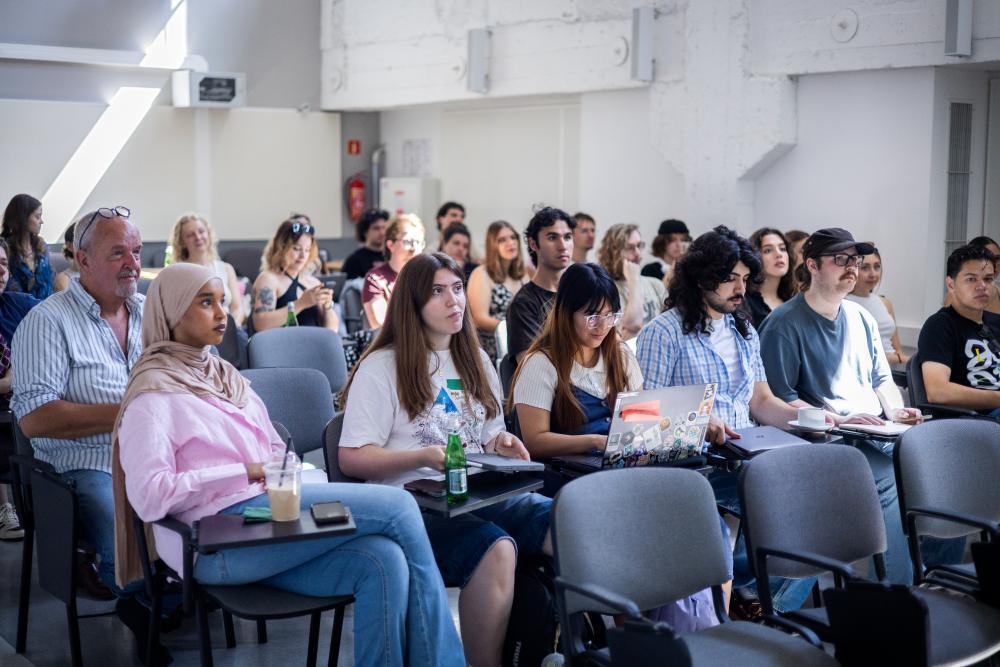 Particpants of "Creative Jam: Communication Design" event at SWPS University in Wrocław
Partners and Patrons
SOCIN 2026 was made possible through the support of our Strategic Partner, SWPS University’s Center for Knowledge Transfer; our Honorary Patrons, the National Centre for Research and Development (NCBR) and the Mayor of Warsaw; and our Patrons, UNEP/GRID-Warszawa, Sieć Przedsiębiorczych Kobiet, and Fundacja Stocznia.
We thank all our partners and patrons for their support and contribution to the success of this year’s conference.
See More Photos form the SOCIN 2026 Conference

The project is co-funded by the European Union. However, the views and opinions expressed are solely those of the author(s) and do not necessarily reflect the official position of the European Union or the European Education and Culture Executive Agency (EACEA). Neither the European Union nor the granting authority can be held liable for them.
Organizers
Strategic Partner
Honorary Patrons
Patrons
ERUA Member Universities
Funding