In recent years, the gap between traditional legal frameworks protecting human rights and the psychological factors that shape human behavior has been gradually increasing. To address this issue, in May 2026, SWPS University in Poznań hosted an interdisciplinary intensive course “Human Rights and the Human Mind”, which gathered international students from seven of the member universities of the European Reform University Alliance (ERUA). The course was coordinated by Dr. Tomasz Lewandowski from the Faculty of Psychology and Law in Poznań.
Effective Human Rights
The initiative operated on the premise that effective human rights protection cannot rely solely on normative analysis; instead, it must integrate insights from psychology, particularly regarding trauma, memory, emotional functioning, cultural diversity, and mental autonomy.
Over three days, participants from Bulgaria, Germany, Greece, Italy, Lithuania, Poland, and Spain, explored pressing contemporary challenges, including the rise of artificial intelligence and biometric technologies, the limits of judicial interpretation, and the legal consequences of psychological vulnerability in decision-making.
On the Polish side, the course was coordinated by Dr. Tomasz Lewandowski from the Faculty of Psychology and Law in Poznań, whose conceptual framework established the program as an interdisciplinary platform combining doctrinal legal analysis with practical reasoning and behavioral insight.
Day 1: Human Rights Framework and Interpretative Challenges
The first day of the course introduced participants to the foundations of human rights protection and how courts shape legal standards. The sessions blended legal theory with behavioral insights through the following presentations and workshops:
- Mental Integrity and Autonomy: Dr. Tomasz Lewandowski connected human rights law with psychology, using ECHR case law to discuss state intervention, identity, and psychological pressure.
- The Human Factor in the Judiciary: Zuzanna Rubaszewska compared civil and common law systems to examine how judges make decisions, focusing on judicial activism and how courts apply implicit psychological assumptions.
- AI and Emotion Recognition: Gabriela Krawczyk led a hands-on workshop on AI emotion recognition and ECHR Article 8, highlighting risks like bias, privacy violations, and cultural misinterpretation.
Human rights law is no longer only about interpreting norms. It is increasingly about understanding the person to whom those norms apply – their cognitive limitations, their psychological condition, and the context of their decisions.
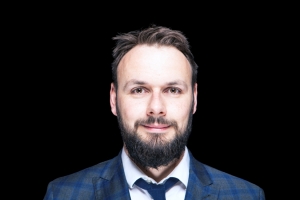
Lewandowski, Tomasz
Course Coordinator, Faculty of Psychology and Law in Poznań, SWPS University
Specialization
lawyer and public administration specialist, expert in international law
First and last name
Tomasz Lewandowski
Academic degree or title
Ph.D. / Assistant Professor
Email
This email address is being protected from spambots. You need JavaScript enabled to view it.
Role in the Faculty
{"funkcja-na-wydziale0":{"Funkcja":"Vice-Dean for Educational Affairs","\u0141\u0105cznik":"at the","Nazwa w mianowniku":"Faculty of Psychology and Law in Pozna\u0144"}}
Role in the Department
{"funkcja-w-katedrze0":{"Funkcja":"","\u0141\u0105cznik":"","Nazwa w mianowniku":"Department of Public Law and Legal Theory"}}
Role in the Research Center
[]
Ph.D. / Assistant Professor Tomasz Lewandowskilawyer and public administration specialist, expert in international law
Day 2: Psychological Vulnerability and Evidentiary Challenges
The second day focused on how psychological processes affect legal assessments in situations involving vulnerability, particularly in family law and criminal proceedings. The sessions explored these complex dynamics through the following presentations and discussions:
- The Best Interest of the Child: Dr. Aleksandra Rytelewska analyzed how legal systems balance protection and autonomy for the developing mind, drawing on both international and European standards.
- Trauma and Testimony Credibility: Defense attorney Olga Biernacka discussed how psychological factors like fragmented memory and delayed reporting affect evidentiary assessments, especially for victims of violence and sexual offenses.
- Childhood, Trauma, and Vulnerability: Dr. Tomasz Lewandowski led an integrative discussion where participants connected legal theory with practical reasoning to synthesize the insights gained throughout the day.
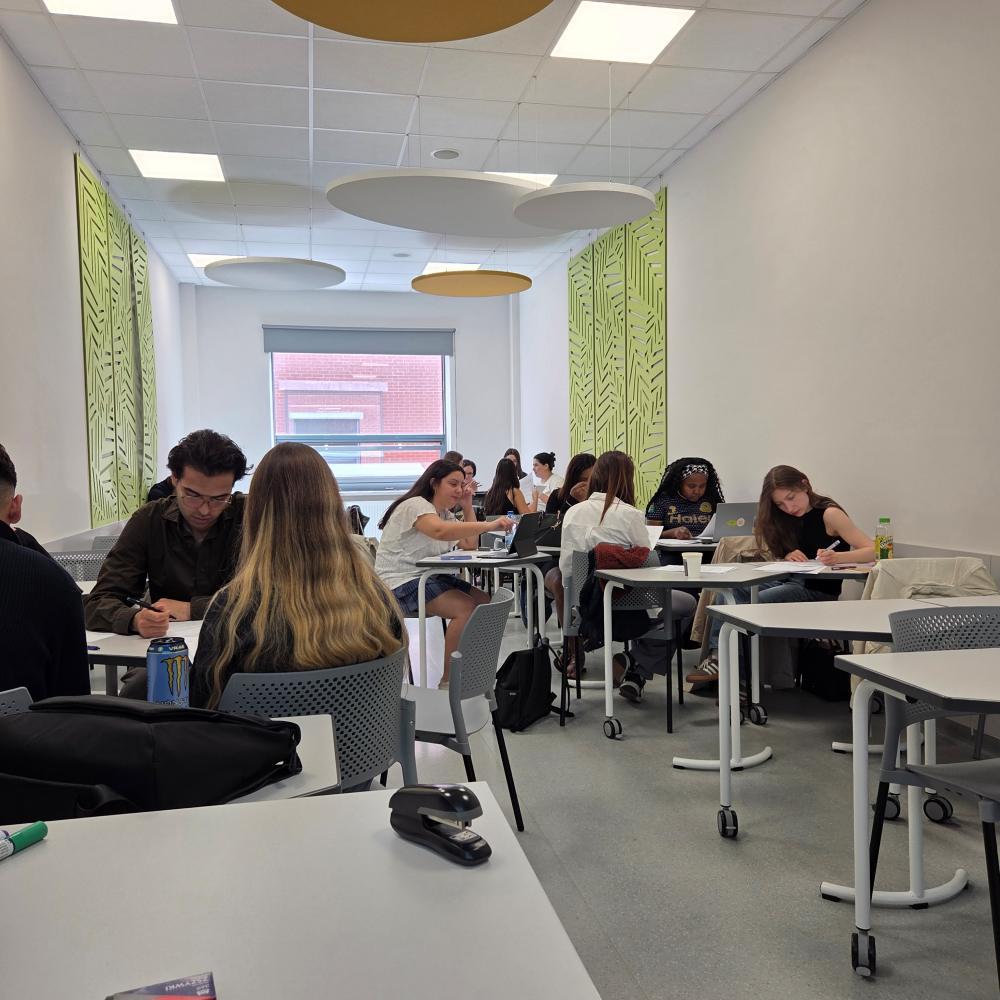 International students attending the "Human Rights & the Human Mind" ERUA course work in gropus during workshop at SWPS University in Poznań.
Day 3: Responsibility, Legal Practice, and Application
The final day shifted focus toward professional practice, responsibility, and applying interdisciplinary knowledge to real-life legal situations. The program concluded with the following workshops and lectures:
- Client Relations and Communication: Jakub Rzeźnikowski led simulation-based exercises exploring what happens when clients act against their own legal interests, as well as how cultural differences and cognitive biases affect lawyer-client communication.
- Criminal Responsibility and Mental Capacity: Prof. Piotr Jóźwiak analyzed the link between mental condition and liability, focusing on how legal systems can protect vulnerable individuals while maintaining the coherence of criminal law.
- Integrating Law and Psychology: Dr. Tomasz Lewandowski wrapped up the course with a final session, inviting participants to reflect on the challenges and importance of using interdisciplinary approaches to tackle modern human rights issues.
Cooperation with Legal Practice: Poznań Bar Association
A distinctive feature of the course was its strong connection to real-world practice, delivered in close cooperation with the Poznań Bar Association. Contributions from attorney Olga Biernacka and trainee attorneys (aplikanci adwokaccy) ensured participants gained both academic analysis and practical insights into litigation and client representation, especially in cases involving psychological vulnerability.
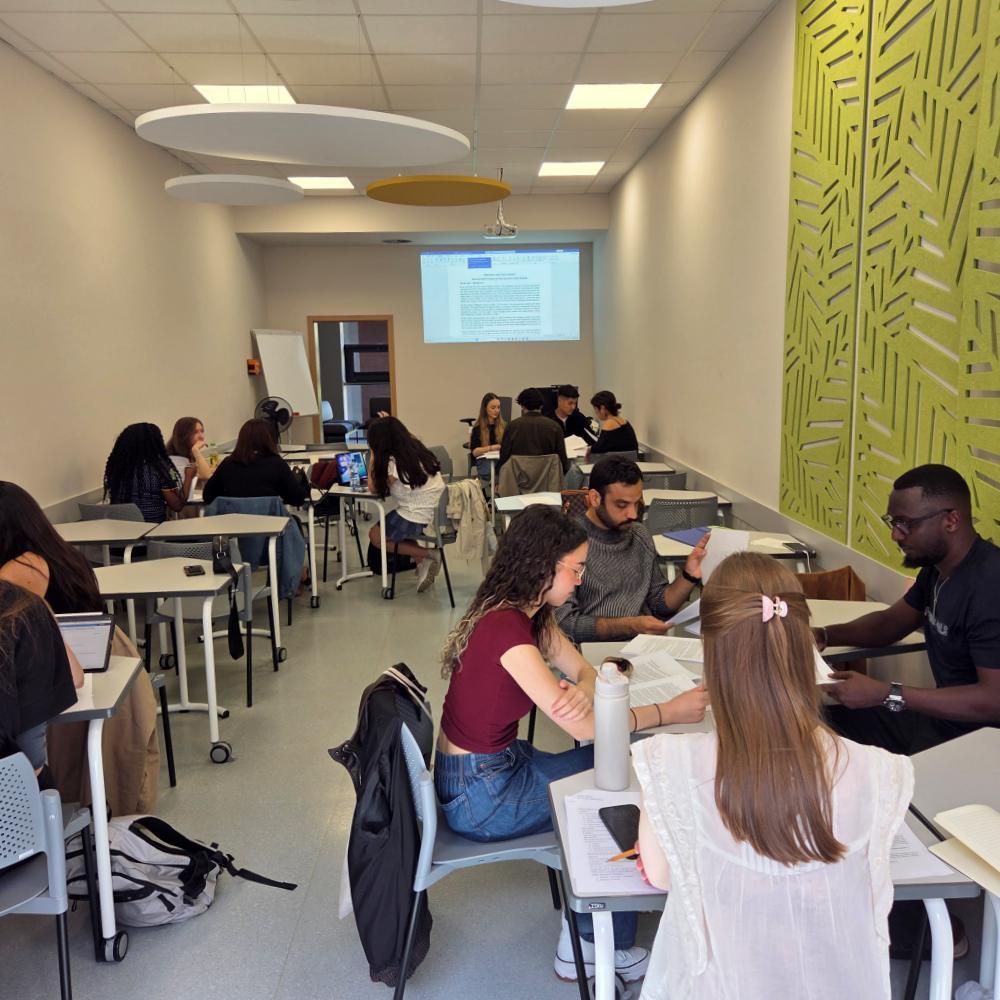 Particpants of the course discuss various issues concerning human rights.
Learning Experience and Outcomes
The course fostered an intensive, collaborative environment through small-group work, case analysis, and interdisciplinary discussions. Participants actively analyzed legal scenarios, debated interpretive dilemmas, and applied European Convention on Human Rights (ECHR) standards to complex, real-life contexts.
Strong participation from European Reform University Alliance (ERUA) students added a vital international and comparative dimension to the program. This diversity of legal backgrounds allowed participants to confront different legal traditions and various approaches to human rights protection.
ERUA Member Universities
Funding